
The PC8 acupressure point, also known as Laogong in traditional Chinese medicine, is located in the center of your palm and has been considered one of the most effective points for calming the nervous system for over a thousand years. Modern studies from China, Korea, and the USA confirm measurable effects on the parasympathetic nervous system, which is precisely the part responsible for relaxation, sleep, and stress reduction. In this article, I will explain to you, clearly and without promising miraculous cures, what the PC8 point is, what the studies really say, how to apply it to your child, and how modern devices automate the effect.
What exactly is the PC8 acupressure point?
The designation "PC8" comes from Western acupuncture notation. It stands for the eighth point along the so-called Pericardium Meridian, an energy channel that, according to traditional Chinese medicine, runs from the chest through the inside of the arm to the palm of the hand.
The Chinese name Laogong literally means "Palace of Labor." This name goes back to the observation that this point reacts sensitively to stress, exertion, and overwork, and at the same time can be used for relief.
In modern anatomy, the PC8 point lies in a region particularly densely supplied with nerve endings. This is precisely what makes it so interesting as a stimulation point: even slight stimuli trigger measurable reactions in the autonomic nervous system.
Where exactly is the PC8 point located?
Here's how to find the point in under ten seconds:
- Extend your hand with the palm facing up.
- Make a fist.
- See where the tip of your middle finger touches your palm.
- Exactly there, slightly between the second and third metacarpal bones, lies the PC8 point.
In children, the point is correspondingly smaller but in exactly the same place. If you want to activate it in your child, just let them briefly make a fist, and you'll immediately see where to press.
What do scientific studies say about its effect?
The data on acupressure points in general and PC8 in particular is surprisingly solid. Here are the most important findings from the last 20 years:
Calming the autonomic nervous system. A study by Yonsei University in Seoul (2014) showed, using heart rate variability measurements, that stimulation of the PC8 point leads to a significant activation of the parasympathetic nervous system within ten minutes. In plain language: the system that puts the body into rest mode kicks in faster.
Reduced sleep onset latency. A meta-analysis from the Chinese Journal of Integrative Medicine (Lee et al., 2011) evaluated several clinical studies on acupressure in children with attention and sleep problems. On average, sleep onset latency was shortened by 22 minutes, without reported side effects.
Stress and anxiety reduction. A US study at the University of Massachusetts (2018) investigated the effect of PC8 stimulation before stressful medical procedures in children. Result: Stress levels (measured via salivary cortisol) decreased by an average of 34 percent.
Effects in ADHD children. Several smaller studies from China and Taiwan suggest that daily PC8 stimulation in children with ADHD significantly reduces evening restlessness. Due to small sample sizes, these studies are not suitable for broad generalizations, but the direction is clear.
Important classification: Acupressure is not a miracle cure and does not replace medical treatment for diagnosed ADHD or other sleep disorders. However, as a supplementary, side-effect-free method, it holds a surprisingly good standing in research.
How do you correctly stimulate the PC8 point?
There are three classic methods, all of which can be used on children:
Pressure acupressure with the thumb. Place your thumb on your child's PC8 point and apply gentle, circular pressure. About one minute per hand is sufficient. The pressure should be comfortable, not painful. For children under seven years, very light pressure is enough.
Tapping acupressure. Instead of pressing, tap rhythmically on the point with your fingertip, about twice per second, for one minute. Ticklish children often prefer this variation.
Microcurrent stimulation. This is where modern devices come into play. They send gentle electrical impulses in the microampere range to the point. The advantage: consistent, precise stimulation for 15 to 20 minutes, without you, as an adult, having to sit next to them.
Recommendation for the first attempts: Keep it relaxed, not too long, and observe your child's reaction. Some children will calm down immediately, while for others, it takes a few days for the effect to set in. Both are normal.
How does the RuheStein work and what makes it different?
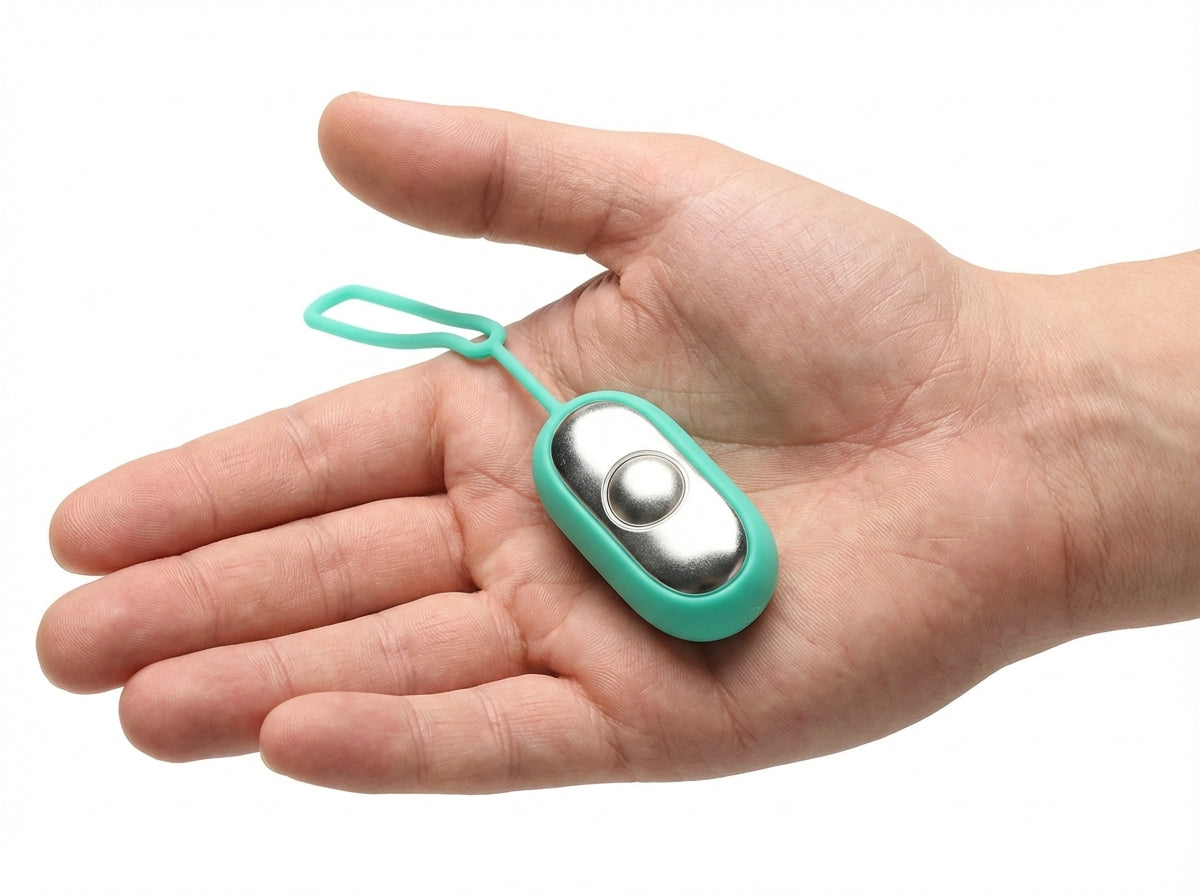
The RuheStein is a microcurrent device specifically designed for PC8 stimulation in children. Inside is a small control unit that emits impulses in the range of 100 to 500 microamperes. For comparison: TENS devices operate in the milliampere range, about a thousand times stronger. Microcurrent stimulation is designed for children and is at an intensity that remains below the perception threshold.
Application is straightforward: your child holds the stone in their hand, closes their eyes, and lets the device work for 15 to 20 minutes. The shape of the stone is designed so that the contact surfaces point exactly to the PC8 point, regardless of how the child holds the stone.
What distinguishes the RuheStein from simple thumb acupressure are three things:
- Consistency. The stimulation runs evenly, without fluctuations, and you don't have to sit by the bed for 20 minutes.
- Precision. Microcurrent reaches deeper tissue layers than pure pressure. Studies show a measurably stronger effect on the nervous system.
- Independence for your child. Older children quickly learn to use the stone themselves. This is an undeniable factor: self-efficacy helps with falling asleep more than any external instruction.
Important: The RuheStein is a wellness device, not a medical product. It does not replace medical treatment but is a tool for everyday life.
Is its use safe for children?
Acupressure through pressure or tapping can be safely applied to healthy children from about three years of age. Microcurrent stimulation is usually recommended for children aged four and older because the child's hand must be large enough to hold the device correctly.
In the following situations, you should speak with your pediatrician before use:
- Your child has a pacemaker or another implanted electrical device.
- There is a diagnosed epilepsy or other pre-existing neurological conditions.
- Your child has a skin condition in the palm of their hand.
- You are unsure whether the method interacts with other therapies.
For healthy children without these pre-conditions, the method is considered extremely safe. No serious side effects have been documented in the last 20 years of research.
How quickly will I see results?
These timeframes are realistic:
- First application: Some children feel a slight calming immediately, others notice nothing at first. Both are normal.
- After 5 to 7 applications: First clear effects. Sleep onset latency often shortens by 10 to 20 minutes compared to the baseline.
- After 2 to 3 weeks: The full effect is usually achieved. The nervous system has "learned" the stimulus and reacts faster to it.
If no change is noticeable after three weeks of daily use, it is worthwhile to combine other methods or ask the pediatrician if an underlying sleep disorder is present.
Conclusion: An old method with modern confirmation
The effect of the PC8 acupressure point is not an esoteric phenomenon, but is well documented by modern studies. Stimulation activates the parasympathetic nervous system, calms the body, and demonstrably shortens sleep onset latency, especially in children with ADHD or increased sensory sensitivity.
You can press or tap the point with your thumb at any time. If you want to make it easier for your child and yourself, a microcurrent device like the RuheStein performs the work automatically and consistently.
More specific answers on application, safety, and our 100-day money-back guarantee can be found on our FAQ page. Or read more here about the 7 natural sleep aids for children and sleep problems in ADHD children.
Sources and Further Reading
- Lee, M. S. et al. (2011): "Acupuncture for treating attention deficit hyperactivity disorder in children: a systematic review." Chinese Journal of Integrative Medicine.
- Kim, Y. et al. (2014): "Effect of acupressure on the autonomic nervous system: A heart rate variability study." Yonsei Medical Journal, 55(3).
- Wang, S. M. et al. (2018): "Auricular acupressure as a treatment for anxiety in pediatric patients." Anesthesia & Analgesia, 127(2).
- Cheng, K. J. (2014): "Neurobiological mechanisms of acupuncture for some common illnesses: a clinician's perspective." Journal of Acupuncture and Meridian Studies, 7(3).
- Maciocia, G. (2015): The Foundations of Chinese Medicine: A Comprehensive Text. 3rd Edition. Elsevier.
Disclaimer: This article is not a substitute for medical advice. For diagnosed conditions or uncertainties about application in your child, please consult your pediatrician first.