
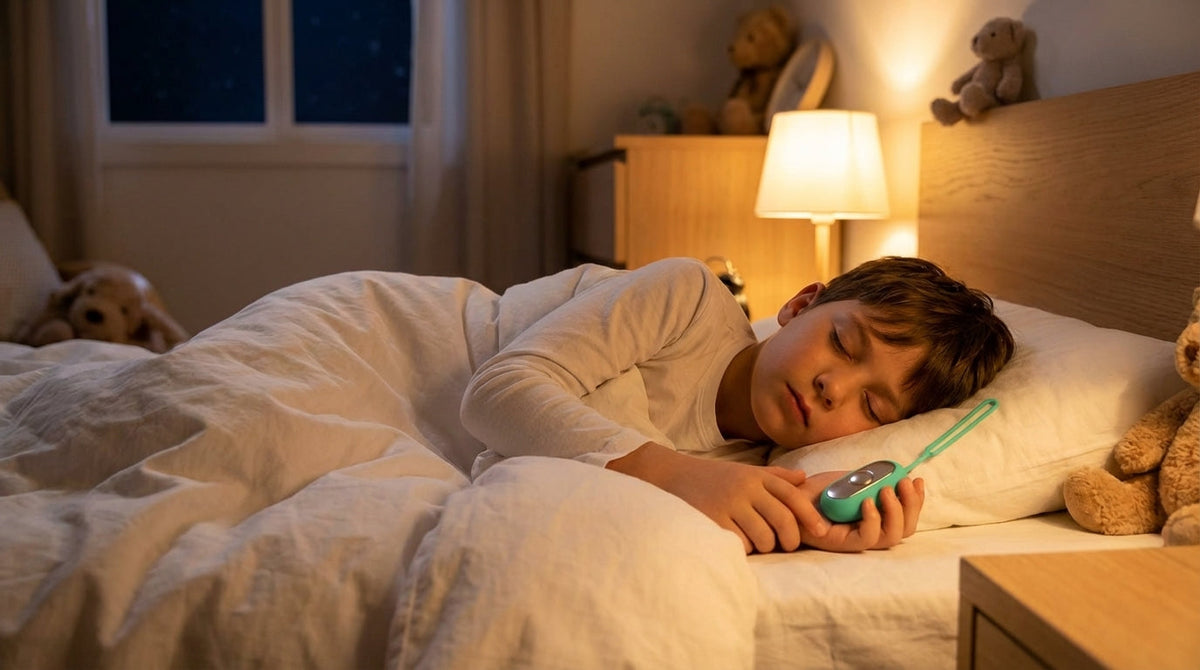
If you want to establish an evening routine for your ADHD child, you don't need a perfect Pinterest list. You need a clear, predictable routine that your child can follow in their sleep after two weeks. Studies show that children with a consistent bedtime routine fall asleep 25 percent faster on average than children without one. For ADHD children, the effect is even stronger because their nervous system relies particularly on predictability. In this article, I will show you a concrete schedule from 6 PM to 8 PM, what you should do in what order, and which classic mistakes you must avoid.
Why do ADHD children need a different evening routine?
The ADHD brain does not wind down on its own in the evening. Dopamine and noradrenaline, which keep it awake during the day, remain elevated longer. The reward system is always looking for the next stimulus. If you don't provide a clear framework for your child, their brain will seek out this stimulus itself, usually in the form of a tablet, an argument, or a sing-song game in bed.
A good evening routine replaces the missing "internal brake" with external structure. It acts like a conveyor belt: once started, everything moves almost automatically towards sleep.
The second effect: predictability calms the nervous system. Cortisol drops, melatonin can rise earlier, and the brain automatically associates the sequence with tiredness after 14 days. You can find more about the biological background in our article why ADHD children can't settle down in the evening.
What does a concrete schedule look like?
This plan is a suggestion for a school-aged child between 6 and 10 years old. You can shift the times by an hour, depending on when your child needs to wake up. The order and consistency are important, not the exact minute.
6:00 PM - Family dinner. As light as possible, no sugary or caffeinated drinks (even diet cola or iced tea should be avoided). Studies show that iron and magnesium are often in the lower normal range in ADHD children. Both help with falling asleep. Bananas, oatmeal, and wholemeal bread are good evening foods.
6:30 PM - Get movement out of the body. Trampoline, jumping jacks, walk around the garden. 10 to 15 minutes of light exercise help to release the last energy in a controlled way. Caution: Don't get too wild, otherwise the nervous system will rev up again.
7:00 PM - Screens off, dimmed lights. Tablets, TV, smartphones away. Ceiling lights off, warm desk lamp on. Blue light has been shown to block melatonin production for up to 90 minutes.
7:15 PM - Warm bath or shower. Optional, but proven effective. The body cools down slightly after a bath, which naturally induces tiredness. 5 to 8 minutes are sufficient.
7:30 PM - Pajamas, teeth, toilet. Always in the same order, without discussion. If you wish, create a small card routine with pictures for your child to follow.
7:40 PM - Quiet activity in bed. Reading aloud, quiet music, audiobook, or acupressure at the PC8 point. This phase should last 15 to 20 minutes. This is also the ideal time for a microcurrent device like the RuheStein, which automatically stimulates the acupressure point. More about its effect can be found in our article on the PC8 acupressure point.
8:00 PM - Lights out, a quick goodnight, leave. Don't sit by the bed for hours. A clear end helps more than a prolonged, drawn-out goodbye.
What mistakes do most parents make?
From practice and studies, we know that these mistakes almost always lead to the routine failing:
1. Starting too late. Many parents only start at 7:30 PM or 8:00 PM. By then, the child is already overstimulated, and the routine acts as an emergency brake instead of a transition. The ideal start time is 90 to 120 minutes before bedtime.
2. Screens "just for a moment." There's no such thing as "just 10 minutes of YouTube" for ADHD children. The stimulus lingers in the nervous system. If at all, then no earlier than 90 minutes before sleep, ideally not at all.
3. Talking too much. Long conversations, discussions about the day, arguments about homework. This activates the brain instead of calming it. Save important conversations for the next morning.
4. Inconsistency on weekends. The internal clock needs constancy. A one-hour deviation from the weekday is okay, but no more. Otherwise, the child pays the price on Sunday evening.
5. Softening the routine at every resistance. For the first 10 days, your child will test the new routine. Stay calm and consistent. After 14 days, the resistance almost always turns into acceptance.
What to do if the child is still awake after 20 minutes?
Reality: Even with the best routine, ADHD children often take longer. A few strategies that help:
- Breathing technique. 4-7-8 breathing, three rounds. Activates the vagus nerve and measurably calms the nervous system.
- Body scan. Tell your child to imagine warm cocoa slowly flowing from their toes to their head. 3 to 5 minutes are often enough.
- Acupressure. Gently press the PC8 point in the middle of the palm for one minute per hand. Also works with the thumb or a microcurrent device.
- Stay calm. If you get stressed, it transfers. A sober "It's okay, just lie still, sleep will come" is more effective than any trick.
What you should not do: Let the child get up again, give them a tablet, or argue with them about why they should sleep now. All of these significantly prolong the wake phase.
How long does it take for the routine to work?
Realistic expectation:
- Day 1 to 3: Resistance and skepticism. Little change, perhaps even more arguments than before.
- Day 4 to 7: First signs that the child recognizes the sequence. Sleep onset time shortens by 10 to 15 minutes.
- Day 8 to 14: Routine is established. The brain automatically switches at the beginning of the sequence. Sleep onset time is often already at 20 to 30 minutes.
- From week 3: Stable phase. There are always bad days, but the trend is clear.
If there is no improvement after four consistent weeks, it is worth talking to your pediatrician to see if there are additional signs of an independent sleep disorder.
Conclusion: Consistency beats complexity
The best evening routine for ADHD children is not the most elaborate, but the one you follow consistently every evening. Keep it lean: eat, move, screens off, bath, pajamas, read aloud or acupressure, lights out. Seven steps, always the same, always in the same order.
Plan two to four weeks for its establishment. Stick with it on weekends too. And if it remains difficult despite everything, combine it with methods like PC8 acupressure or check out the 7 natural sleep aids that we have described in detail in a separate article.
More specific answers regarding safety, application, and money-back guarantee for the RuheStein can be found on our FAQ page.
Sources and further reading
- Mindell, J. A. et al. (2009): "A nightly bedtime routine: impact on sleep in young children and maternal mood." Sleep, 32(5).
- Owens, J. A. et al. (2014): "Insufficient sleep in adolescents and young adults: an update on causes and consequences." Pediatrics.
- Cortese, S. et al. (2013): "Sleep in children with attention-deficit/hyperactivity disorder: meta-analysis." Journal of the American Academy of Child & Adolescent Psychiatry.
- Konofal, E. et al. (2008): "Iron deficiency in children with attention-deficit/hyperactivity disorder." Archives of Pediatrics & Adolescent Medicine.
Disclaimer: This article does not replace medical advice. For persistent sleep problems, please consult your pediatrician.