
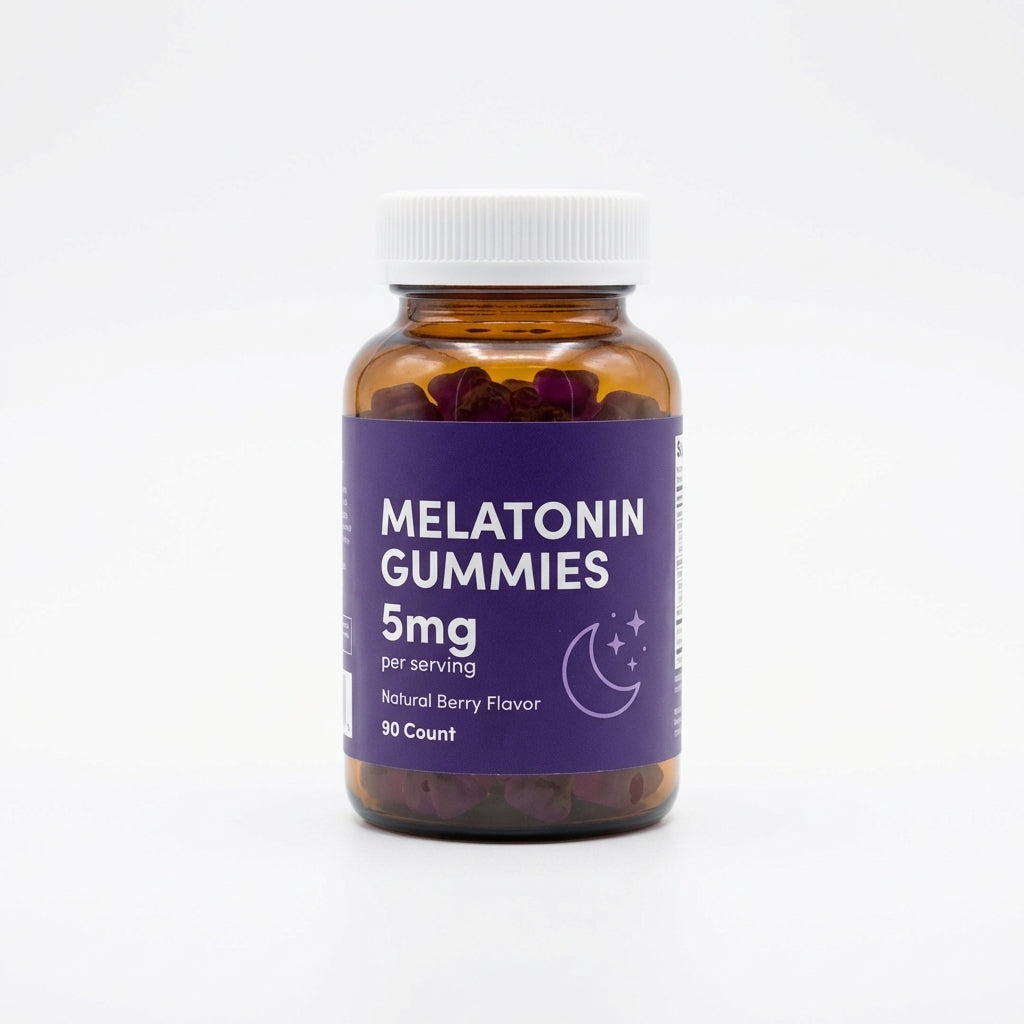
If you're wondering whether melatonin for children with ADHD is the right solution, you're in good company. It's estimated that around 30 percent of German-speaking parents of children with ADHD eventually turn to melatonin, often out of sheer desperation after sleepless nights. The honest answer: melatonin can work in the short term, but it's not a miracle cure and has a downside that few talk about. In this article, I'll neutrally show you what studies say, what pediatricians recommend, what risks are often overlooked, and what natural alternatives exist.
What is melatonin and how does it work in the body?
Melatonin is a hormone that your pineal gland in the brain produces. It signals to your body "it's time for sleep." In healthy adults, melatonin levels rise about two hours before falling asleep, peak at night, and drop again in the morning.
In children with ADHD, this natural curve is often shifted. A much-cited study shows that melatonin secretion in children with ADHD starts an average of 90 minutes later than in age-matched children without ADHD. This explains why your child is in bed in the evening, but their body is not yet biologically ready for sleep.
When you give melatonin as a tablet or drops, you're supplying the hormone from outside. The body thinks it's bedtime for a few hours, and for many children, the time it takes to fall asleep is measurably shortened.
What do studies say about melatonin in children with ADHD?
The data is solid for short-term effects and thin for long-term effects. Here are the most important findings:
Short-term effect. A meta-analysis from the Journal of Child Neurology (2017) evaluated several studies on children with ADHD and found an average reduction in sleep onset latency of 20 to 30 minutes at a dosage of 0.3 to 3 milligrams.
Sleep quality. Several studies show that while melatonin facilitates falling asleep, it doesn't necessarily improve overall sleep quality. Some children fall asleep faster but wake up more frequently at night or report morning fatigue.
Long-term effect. This is where it gets critical. A Dutch study from 2020 followed children with ADHD who took melatonin for years and observed evidence of delayed pubertal development in some subjects. The study is not conclusive, but it is a warning sign.
Tolerance effect. Some children need higher doses over time for the same effect. There is evidence that the body's own melatonin production further decreases with continuous use.
What do pediatricians say about melatonin?
In Germany, melatonin for children requires a prescription; in Austria, it's partially over-the-counter; in Switzerland, it's only available through a doctor. Most German-speaking pediatricians take a nuanced position:
- Behavioral interventions are the first choice. Sleep rituals, stimulus reduction, acupressure, more physical activity during the day. Melatonin should not be the first reflex.
- If melatonin is used, it should be targeted and short-term. For example, for 4 to 12 weeks, at a low dose (often 0.5 to 1 milligram), as a "bridge" while other methods are being established.
- Regular re-evaluation. Every few months, check whether the child still needs melatonin or if other methods are sufficient.
- Caution with pre-existing conditions. Special clarification is necessary for epilepsy, hormonal disorders, or certain medications.
An important recommendation from the German Society for Sleep Research and Sleep Medicine: Melatonin is not a classical sleeping aid, but a timing agent. It only helps where the day-night rhythm is actually shifted.
What risks are often overlooked?
Three points that are rarely mentioned at the pharmacy or when buying over-the-counter:
1. Dosage in over-the-counter products. Studies from the USA have shown that up to 70 percent of melatonin products contained varying amounts of active ingredient. Some had only half, others four times the stated dose. If you opt for prescription products in Germany, the risk is lower, but not zero.
2. Gummy trap. Melatonin gummies taste good to children. The danger: They secretly take more. In the USA, between 2012 and 2021, there was a 530 percent increase in melatonin poisonings in children, often due to overdosing with gummies. Keep everything out of sight and reach.
3. Psychological dependence. Even if melatonin is hardly physically addictive, many children quickly learn "I can only fall asleep if I have my tablet." This psychological dependence is often difficult to get rid of after months.
What natural alternatives are there?
Before or in parallel with melatonin, it's worth trying these methods. They have the advantage of not introducing any active substance into the body and strengthening your child's long-term sleep ability instead of weakening it.
- Consistent evening routine. Predictability is invaluable for ADHD brains. More on this in our article on evening routine for ADHD children.
- Stimulus reduction and screens off. Blue light further blocks the body's own melatonin production. All screens off one hour before sleep.
- Acupressure at the PC8 point. The Laogong point in the palm calms the nervous system. Devices like the RuheStein automatically stimulate it with gentle microcurrent for 15 to 20 minutes, below the perception threshold. More background on the effect of the PC8 point.
- Breathing techniques like 4-7-8. Activates the vagus nerve and measurably switches the nervous system to rest mode.
- Consistent sleep-wake rhythm. Maintain as consistent bedtimes as possible, even on weekends. The internal clock hates jumps.
Unlike melatonin, these methods have no long-term risks and no addiction potential. The downside: They require 2 to 4 weeks of patience to work reliably.
What exactly is the RuheStein?
The RuheStein is a small microcurrent device that stimulates the PC8 acupressure point in the palm. Your child holds the stone in their hand, closes their eyes, and the device calms the nervous system through gentle electrical impulses that are below the perception threshold.
Compared to melatonin, the RuheStein has three advantages: no substance is absorbed into the body, no habituation effect, no risk with accidentally higher doses. The effect is only present during use and then disappears again.
Specific answers to safety, application, and our 100-day money-back guarantee can be found on our FAQ page.
Conclusion: Melatonin as a bridge, not a permanent solution
If your child with ADHD is to take melatonin, it's no shame and not a bad decision, as long as you use it short-term and targeted. What you should avoid: melatonin as a long-term solution for years, without simultaneously working on sleep rituals, stimulus reduction, and methods like PC8 acupressure.
Talk to your pediatrician, give a low dose, and plan from the outset when you will taper it off. In parallel, build a routine that helps your child fall asleep in the long term, even without melatonin.
More about specific sleep aids without medication and sleep problems in children with ADHD can be found in the linked articles.
Sources and Further Reading
- Bijlenga, D. et al. (2019): "The role of the circadian system in the etiology and pathophysiology of ADHD." ADHD Attention Deficit and Hyperactivity Disorders.
- Cortese, S. et al. (2013): "Sleep in children with attention-deficit/hyperactivity disorder: meta-analysis." Journal of the American Academy of Child & Adolescent Psychiatry.
- Bruni, O. et al. (2015): "Current role of melatonin in pediatric neurology: clinical recommendations." European Journal of Paediatric Neurology.
- Lelak, K. et al. (2022): "Pediatric melatonin ingestions, United States, 2012-2021." MMWR Morbidity and Mortality Weekly Report.
Note: This article is not a substitute for medical advice. The administration of melatonin to children should always be discussed with your pediatrician.