
If you're looking for a medication-free sleep aid for children, you're not alone. According to a survey by the University of Tübingen, around 83 percent of German parents want a drug-free solution for their children's sleep problems. The good news is there are seven proven methods that, in most cases, show measurable results without drops, pills, or syrup. In this article, I'll show you what really works, what's just expensive marketing, and the sequence that has proven effective in practice.
Why do so many parents look for alternatives to sleeping pills?
The reluctance to use medication has tangible reasons. In children, active ingredients often work differently than in adults, long-term studies are sparse, and no one wants their child to become dependent when they need help falling asleep.
Furthermore, many sleep problems in children are not medical but behavioral and environmental. Bright light, too much screen time late in the evening, irregular routines, too little physical activity during the day. All of this can be changed without reaching for the medicine cabinet.
Another point often mentioned by sleep specialists: Children who learn to fall asleep independently with small rituals and methods are significantly less likely to experience sleep disorders as adolescents and adults. So, the investment pays off in the long run.
Which 7 methods really work?
These seven approaches are well-supported by studies and are also recommended by pediatricians and sleep specialists. You don't have to implement them all at once. Choose two or three that suit your child and your daily routine, and stick with them for two weeks.
1. The consistent bedtime routine. Children love predictability. Plan the exact same sequence every evening: dinner, brush teeth, pajamas, book, lights out. Studies show that children with a clear bedtime routine fall asleep on average 25 percent faster than children without a fixed evening program.
2. Reduce stimuli one hour before sleep. Screens off, ceiling lights off, dimmed lamps on. The blue light from tablets and TVs has been shown to block melatonin for up to 90 minutes. A warm white desk lamp and quiet activities like reading aloud or drawing prepare the body much better for sleep.
3. Breathing techniques. The "4-7-8 breathing" also works surprisingly well for children aged four and older. Inhale for four seconds, hold your breath for seven seconds, exhale for eight seconds. Three to four rounds, no more. This technique activates the vagus nerve and measurably switches the nervous system into resting mode.
4. Acupressure on the PC8 point. A point in the center of the palm, also called Laogong in traditional Chinese medicine. Gentle pressure or circular motion on PC8 calms the nervous system in a few minutes. If you want to delve deeper, here is the detailed article on the PC8 point.
5. Sufficient physical activity during the day. Children need at least 60 minutes of intensive exercise per day, ideally outdoors. Without this physical exertion, the nervous system simply isn't tired in the evening, no matter how strict the bedtime ritual is. But please not in the last two hours before sleep, otherwise the effect will be reversed.
6. Calming scents and sounds. Lavender oil in a diffuser or a few drops on the pillow have a calming effect on many children. Gentle white noise or soft nature sounds help children who are sensitive to stimuli to block out external noises. Both have been studied for decades and are considered harmless.
7. A consistent sleep-wake rhythm, even on weekends. Sounds boring, but it's one of the most powerful levers of all. Children whose bedtime on weekends deviates by more than 60 minutes from weekdays take an average of 30 minutes longer to fall asleep on Mondays. The internal clock needs consistency.
What about herbal remedies like valerian or hops?
Herbal sedatives are strictly speaking also medications, even if they are available without a prescription. For valerian, hops, lemon balm, or passionflower: The research in children is thin, the dosage is tricky, and some remedies can interact with other medications.
If you want to use herbal teas or drops, talk to your pediatrician or a pharmacy that is familiar with pediatric dosages beforehand. And see these remedies as a short-term bridge while you simultaneously work on sleep rituals and methods like PC8 acupressure. They are not a permanent solution.
How do devices like the RuheStein help?
Acupressure on the PC8 point fundamentally also works with the thumb. In practice, however, this often fails due to two things: You have to sit next to your child for 15 to 20 minutes and apply even pressure, and many children get impatient when an adult stays by their bed for so long.
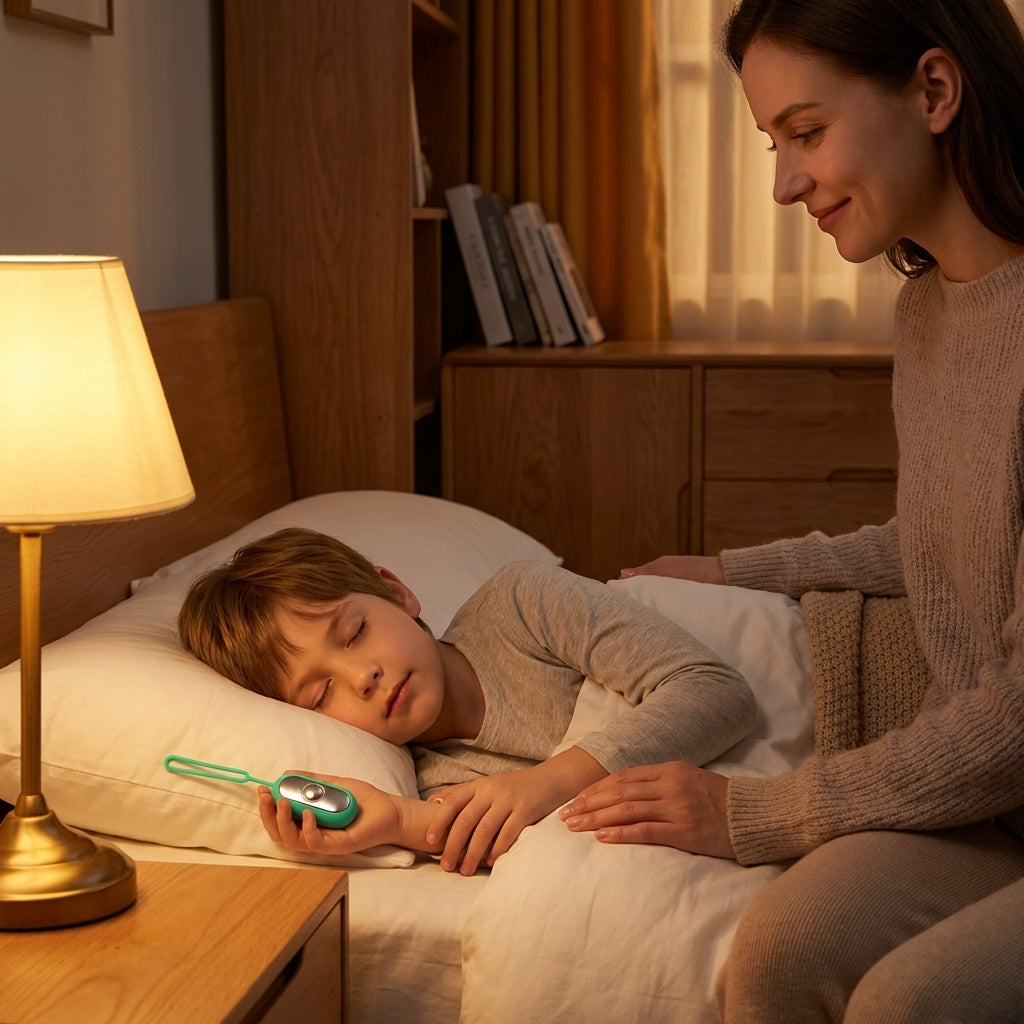
This is where microcurrent devices come in. The RuheStein is a small handheld device designed specifically for the PC8 point. Your child holds the stone in their hand, closes their eyes, and the device automatically stimulates the point with gentle microcurrent. You can do laundry next door or put a sibling to bed.
The crucial advantage: It is not a substance that is absorbed into the body. No active ingredient, no liver burden, no habituation. The stimulation only works during application, after which it is gone. This makes the approach particularly attractive for parents who want to avoid any form of substance.
Important to know: Microcurrent stimulation at acupressure points is not the same as electrostimulation or TENS. The intensity is in the microampere range and is safe for children aged four and older.
What should you expect in the first two weeks?
An honest answer: no miracles overnight. Your child's nervous system needs time to learn new routines. These progressions are realistic:
- Days 1 to 3: Little change, your child needs to get used to the new ritual, there might even be resistance.
- Days 4 to 7: First improvements, the time to fall asleep is reduced by an average of 10 to 15 minutes.
- Days 8 to 14: The new ritual is established, your child recognizes the steps and reacts with tiredness. Sleep onset times of 20 to 30 minutes are realistic.
- From week 3: Routine established. Bad phases are still possible but occur less frequently.
If there is no improvement at all after four weeks of consistent implementation of two or three methods, it is a clear signal that a pediatrician or a sleep clinic should take a look.
When are natural methods not enough?
There are sleep problems that need to be medically clarified because they may be caused by an underlying condition. Pay attention to these warning signs:
- Your child snores loudly regularly or has breathing pauses (suspected obstructive sleep apnea).
- They complain of tingling, burning, or an urge to move in their legs when falling asleep (Restless Legs Syndrome).
- They have night terrors or sleepwalk repeatedly.
- Despite consistent implementation, the time to fall asleep does not improve at all over four weeks.
In these cases, natural methods are still helpful but do not replace medical evaluation.
Conclusion: Patience pays off
An effective medication-free sleep aid for children is not a single method, but a combination of two or three components that suit your child. A sleep ritual and stimulus reduction are the basis that always works. PC8 acupressure and breathing techniques are strong additions that can be integrated into the evening in 10 to 15 minutes. Devices like the RuheStein relieve you of the time burden of manual acupressure.
Plan two to four weeks for the transition, document the sleep onset times in a small notepad, and be patient with yourself and your child. You're doing it right.
You can find more specific answers about safety, use, and age limits on our RuheStein FAQ page. Or read on here if you are specifically interested in sleep problems in children with ADHD.
Sources and further reading
- Mindell, J. A. et al. (2009): "A nightly bedtime routine: impact on sleep in young children and maternal mood." Sleep, 32(5).
- Chang, A. M. et al. (2015): "Evening use of light-emitting eReaders negatively affects sleep, circadian timing, and next-morning alertness." PNAS, 112(4).
- Lillehei, A. S. & Halcon, L. L. (2014): "A systematic review of the effect of inhaled essential oils on sleep." The Journal of Alternative and Complementary Medicine, 20(6).
- Lee, M. S. et al. (2011): "Acupuncture for treating attention deficit hyperactivity disorder in children: a systematic review." Chinese Journal of Integrative Medicine.
Note: This article does not replace medical advice. For persistent sleep problems in your child, please consult your pediatrician or a sleep clinic.